- Parking Lot Maintenance
- #Parking striping
- #Line striping
- #ADA parking
- #Thermoplastic
- #Lakeland
- #Polk City
- #Orlando
- #Polk County
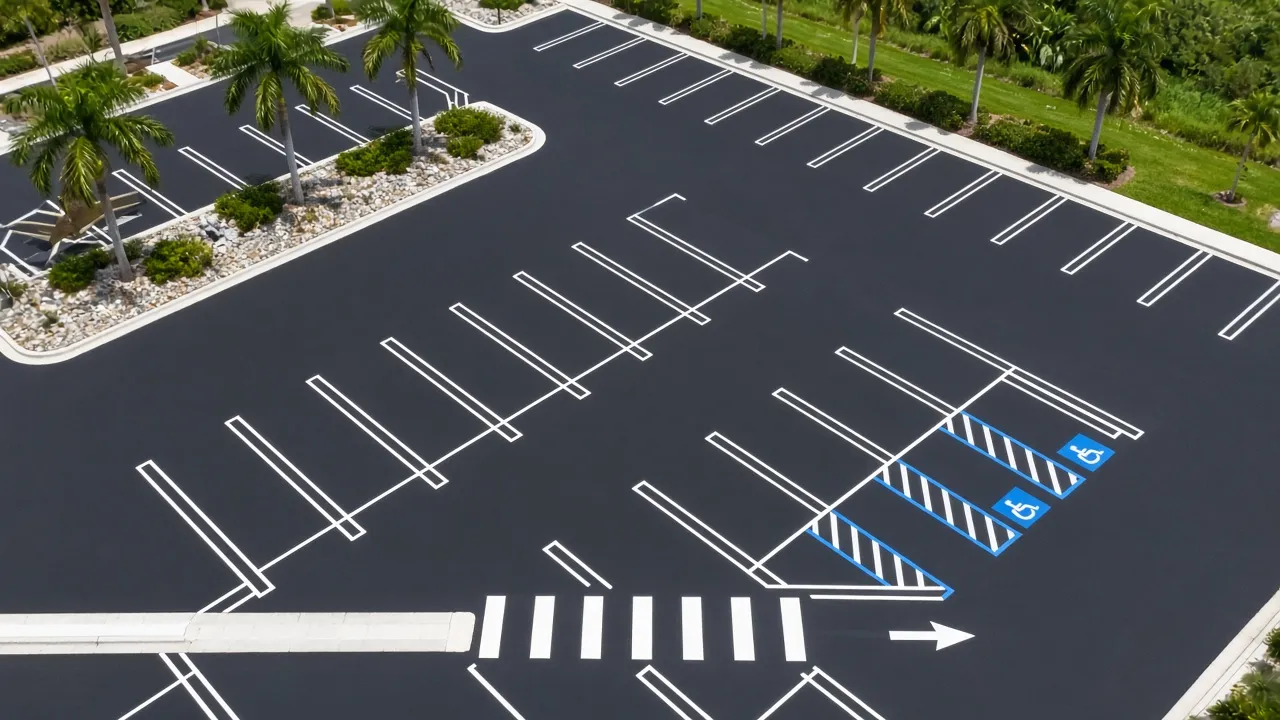
Illustration: a striped parking lot layout. Not an A1 Paving project.
Short answer: Parking lot line striping in Florida means planning a layout, sizing standard and accessible stalls, and keeping lines visible. Florida law requires accessible spaces at least 12 feet wide with 5-foot striped aisles, outlined in blue. Most lots use traffic paint for stalls and thermoplastic for high-wear crosswalks and arrows, and need inspection at least yearly.
By Bill Cooper, A1 Paving, based in Polk City, FL.
Whether you manage a retail center in Lakeland, an office or church lot in Polk City, or a property in Orlando, striping is one of the cheapest ways to make a lot safer and easier to use. This guide covers what owners should know before calling a contractor. For the service itself, see A1 Paving’s parking lot line striping service.
Why does parking lot striping matter?
- Safety. Lines, arrows and crosswalks tell drivers where to go and where to watch for people on foot.
- Capacity. A clear stall layout helps drivers park evenly, so the lot holds the number of cars it was designed for.
- Compliance. Accessible parking has specific federal and Florida rules (below), and fire lanes are set by your local fire authority.
- First impressions. Faded lines make a property look neglected before a customer walks in the door.
How should a parking lot be laid out?
A layout decides how many stalls fit, which way traffic flows, where accessible spaces go, and how fire lanes, entrances and walkways connect.
Start with the site plan and local code
For new lots or big changes, work from the property’s approved site plan. Stall sizes, aisle widths and the number of spaces are usually set by your city or county land development code (for example, the City of Lakeland, Polk County, or the City of Orlando), not by a single statewide standard.
Choose 90-degree or angled stalls
- 90-degree stalls fit the most cars and allow two-way aisles.
- Angled stalls (often 45 or 60 degrees) are easier to pull into and usually pair with one-way aisles, but fit fewer cars per foot of curb. Your local code sets the minimum aisle width for each angle.
Place accessible spaces first
Accessible spaces should be on the shortest accessible route to the building entrance (2010 ADA Standards §208.3). Locate them before laying out the rest of the stalls.
Mark traffic flow and pedestrian routes
Arrows, stop lines, crosswalks and fire-lane markings complete the layout. A1 Paving’s striping services include fire lanes, arrows and crosswalks.
What are standard parking stall dimensions?
There is no single Florida law for regular (non-accessible) stall size. Local codes set it, and they differ by city and county. Always check your local code and site plan before changing stall sizes.
Accessible (ADA) stall dimensions in Florida
Two sets of rules apply, and Florida’s is stricter:
| Rule | Federal: 2010 ADA Standards §502 | Florida: F.S. §553.5041 |
|---|---|---|
| Car space width | At least 96 in. (8 ft) | At least 12 ft |
| Access aisle | At least 60 in. (5 ft) | At least 5 ft, striped diagonally as a no-parking zone |
| Van space | 132 in. with 60-in. aisle, or 96 in. with 96-in. aisle (§502.2) | Confirm van space requirements with your local building official |
| Marking | Aisles marked to discourage parking (§502.3.3) | Spaces outlined in blue paint |
| Sign | Required (§502.6) | Permanent sign: “PARKING BY DISABLED PERMIT ONLY” |
The number of accessible spaces a lot needs is set by its total size (2010 ADA Standards §208.2). Sources: 2010 ADA Standards and Florida Statutes §553.5041. This is general information, not legal advice; confirm requirements for your property with your local building official.
How often should a parking lot be restriped?
It depends on traffic, paint type and weather. A busy retail lot fades faster than a lightly used office lot, and Florida’s strong sun and heavy summer rain wear paint down. A practical rule is to inspect the lot at least once a year and restripe when lines are hard to see in rain or at night.
Signs it’s time to restripe
- Lines are faded, chipped or hard to see at night or in rain.
- Drivers park crooked or across two stalls.
- Accessible stalls, blue outlines or aisle hatching have worn off.
- You’ve just sealcoated or resurfaced, which covers old lines.
- The layout no longer fits how the lot is used.
Striping after sealcoating or new paving
Sealcoating covers existing lines, so the lot has to be restriped afterward. A1 Paving stripes after its own sealcoating jobs. New asphalt and fresh sealcoat need time to cure before paint goes down; your contractor will advise on timing. See our commercial parking lot maintenance plan for how striping fits into regular upkeep.
Paint vs. thermoplastic: which is right for your lot?
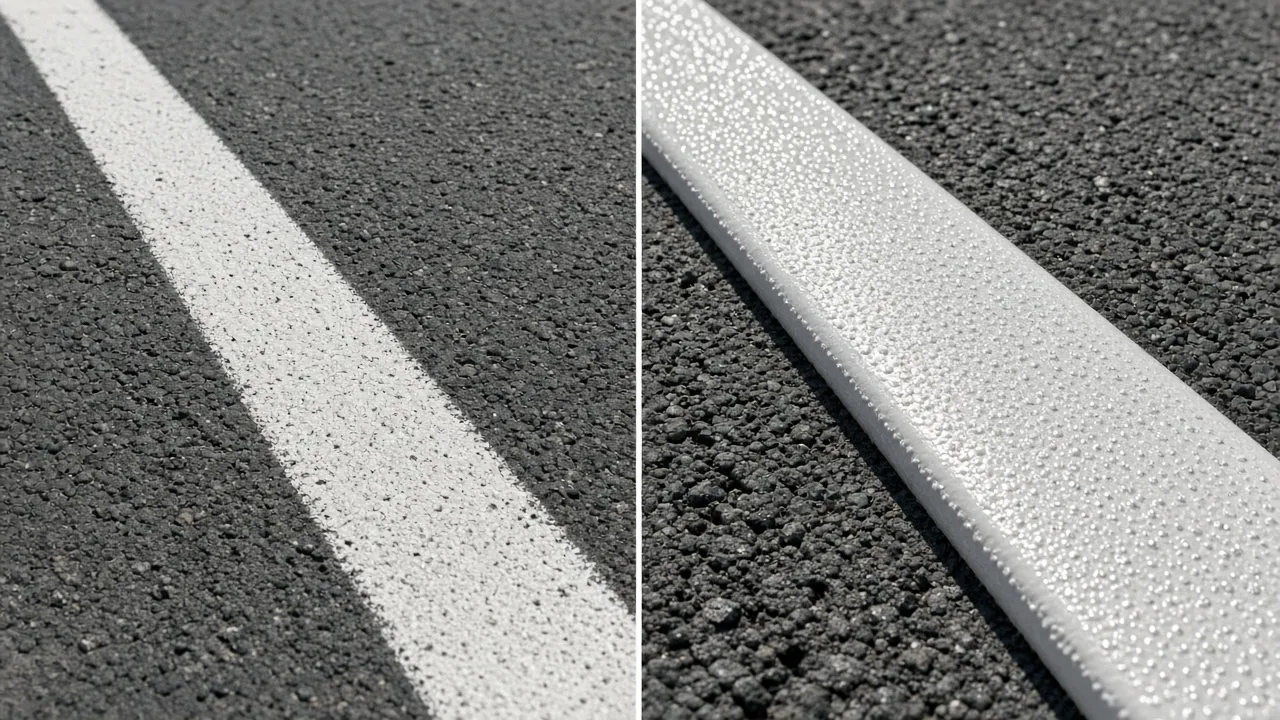 Illustration: traffic paint (left) vs. thermoplastic (right). Not an A1 Paving project.
A1 Paving offers both. The choice usually comes down to how much wear an area gets.
| Traffic paint | Thermoplastic | |
|---|---|---|
| How it’s applied | Sprayed with a striping machine | Heated and melted onto the pavement, bonding as it cools |
| Thickness | Thin film | Thicker, raised layer |
| Best for | Parking stalls, quick refreshes | Crosswalks, arrows, stop lines, high-traffic lines |
| Upfront cost | Lower | Higher |
| Durability | Needs more frequent restriping | Generally lasts longer under heavy traffic |
Many owners use paint for stall lines and thermoplastic for crosswalks and arrows, where tires wear paint fastest. In Florida, public-road thermoplastic is covered by FDOT’s Standard Specifications for Road and Bridge Construction, Section 711, “Thermoplastic Pavement Markings” (FDOT Specifications; products via FDOT PATH). The FHWA MUTCD, Part 3, sets national rules for marking colors and patterns on public roads. Private lots aren’t always bound by those road rules, but they’re a useful benchmark. Learn more on our thermoplastic pavement markings page.
What should owners ask a striping contractor?
- Will you work from my site plan and local code for stall and aisle sizes?
- How will accessible spaces meet both the ADA Standards and Florida §553.5041?
- Which markings will be paint and which thermoplastic, and why?
- When can you work so the lot stays open (nights, weekends, sections)?
- How long before cars can drive on the new lines?
Areas A1 Paving serves
A1 Paving, based in Polk City, provides parking lot line striping in Lakeland, Polk City and across Polk County, as well as Orlando. Free estimates are available.
Conclusion
Good parking lot line striping starts with a layout based on your site plan and local code, accessible stalls that meet both the 2010 ADA Standards and Florida §553.5041, and the right material for each area: paint for stalls, thermoplastic where wear is heaviest. Inspect yearly and restripe when lines fade. If you own or manage a lot in Lakeland, Polk City or Orlando, request a free striping estimate or call A1 Paving at (407) 966-5164.
Frequently asked questions
How wide must an accessible parking space be in Florida? At least 12 feet, with an access aisle at least 5 feet wide striped diagonally as a no-parking zone, under Florida Statutes §553.5041. The space must be outlined in blue and have a permanent sign.
How wide is a standard parking stall? It’s set by your city or county code, not state law. Check the current code for Lakeland, Polk County or Orlando and your site plan.
How often should a parking lot be restriped? Inspect at least once a year and restripe when lines fade or are hard to see in rain or at night. Busy lots need it more often.
Is thermoplastic better than paint for parking lots? Thermoplastic is thicker and generally lasts longer under heavy traffic, so it suits crosswalks and arrows. Paint costs less upfront and is the usual choice for stall lines.
Do I need to restripe after sealcoating? Yes. Sealcoat covers the old lines, so the lot is restriped after it dries. A1 Paving stripes after its own sealcoating.
Does A1 Paving stripe parking lots in Orlando? Yes. A1 Paving, based in Polk City, stripes lots in Lakeland, Polk City, Polk County and Orlando, and offers free estimates.
Next step
Plan your project
Share the property location, intended use, and current surface condition, and A1 Paving Asphalt will review the site and provide a written estimate.