- Commercial Paving
- #Commercial Parking Lot Paving
- #Commercial Asphalt Paving
- #Parking Lot Paving Contractor
- #New Parking Lot
- #Lakeland
- #Orlando
- #Polk City
- #Polk County
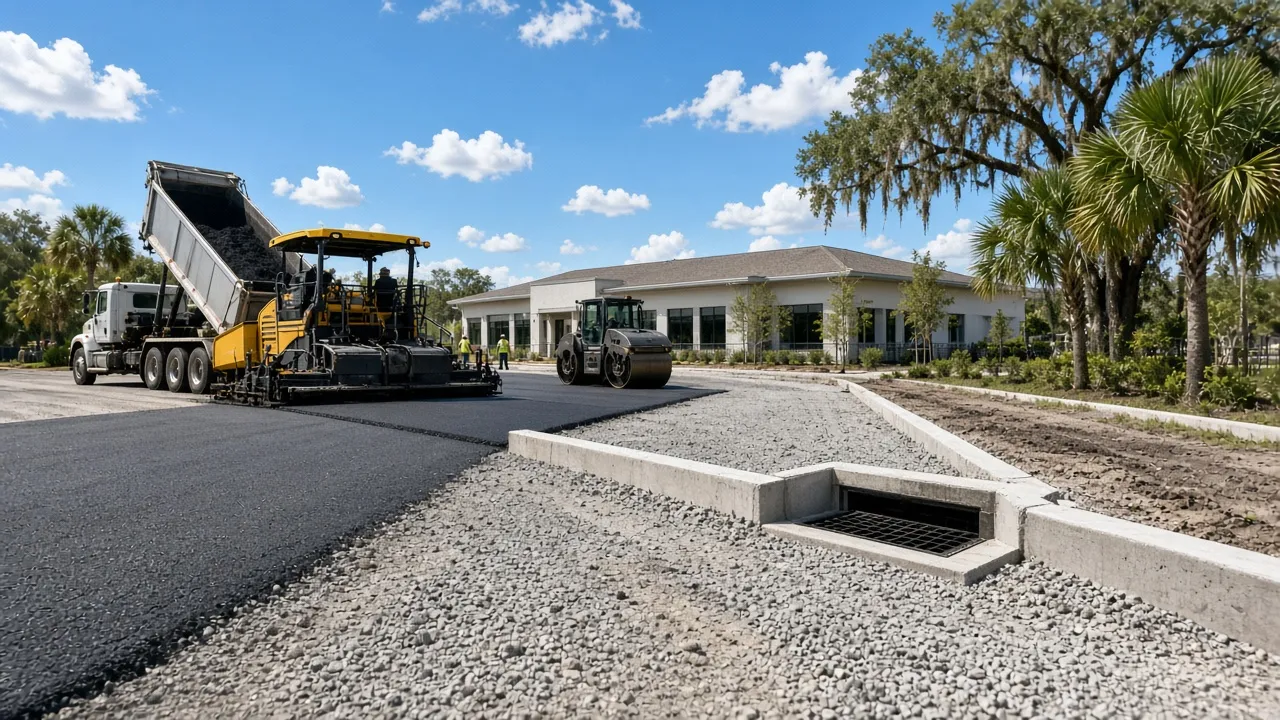
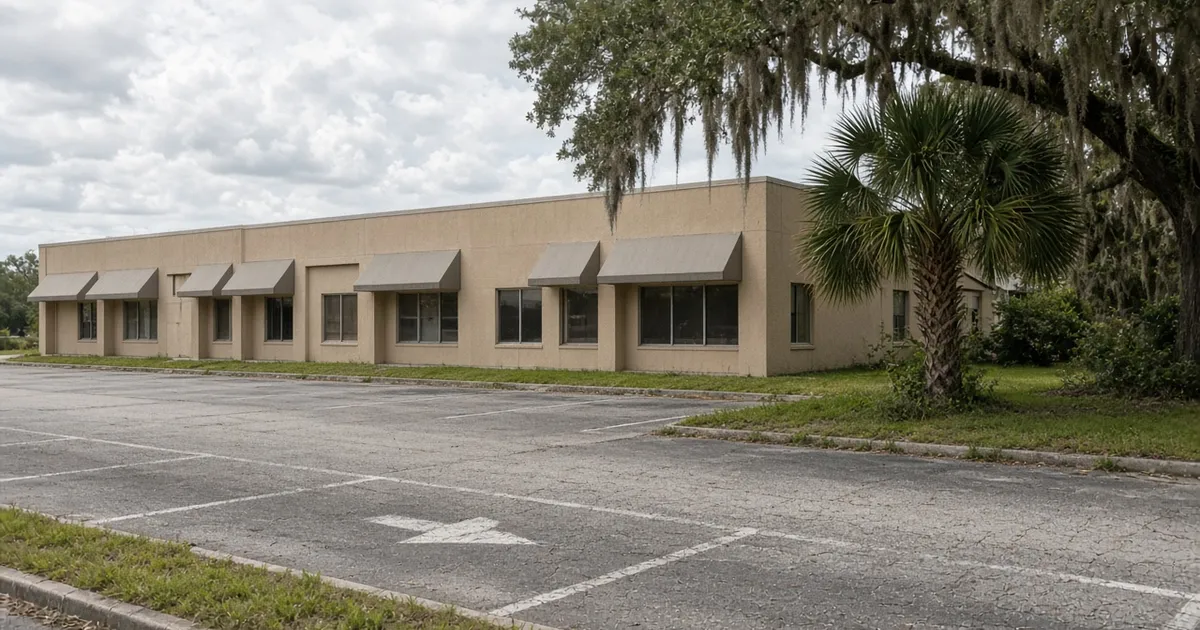
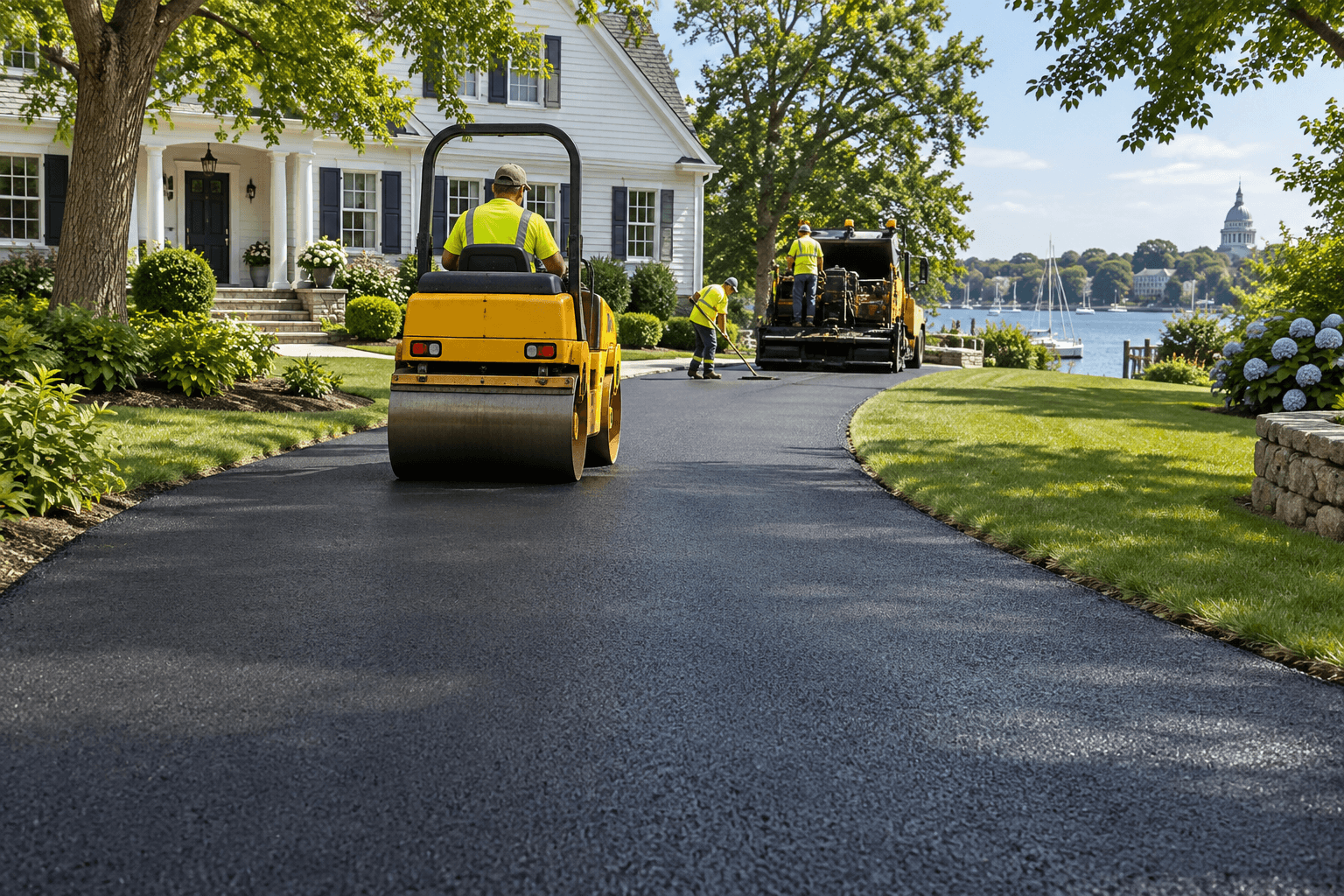
Illustration: a new commercial parking lot being paved at a Central Florida site. Not an A1 Paving project.
Short answer: Commercial parking lot paving on a new lot is built from the ground up in a set order: site prep and grading, drainage, a compacted subgrade and base, asphalt placed and compacted in layers, then striping. How thick those layers need to be depends on the soil under the lot and on the traffic, especially trucks, so it is set by the project’s design rather than a rule of thumb. A new lot in Florida usually also involves stormwater and local site-plan review and accessible parking, which are worth sorting out before paving is priced.
By Bill Cooper, A1 Paving, based in Polk City, FL.
If you are planning a new or expanded parking area in Lakeland, Orlando or Polk County, this guide explains what a new commercial lot involves, in plain language, so you can compare bids and plan your schedule. It is about new lots. For an existing lot, see A1 Paving’s guide to parking lot resurfacing, overlay and mill-and-pave. For the paving itself, see the asphalt paving service.
What are the steps to pave a new commercial parking lot?
A new lot goes in layer by layer, and each step depends on the one before it. The usual order is site prep, grading, drainage, base, asphalt layers, compaction and striping.
- Site prep. Debris, topsoil, vegetation and any unsuitable material come out of the lot area and are replaced with suitable material. Underground utilities are located before anyone digs. In Florida that means a request to Sunshine 811 (Chapter 556, Florida Statutes).
- Grading and subgrade. The soil under the pavement is the foundation. The Missouri Asphalt Pavement Association (MAPA), in its Asphalt Parking Lot Design guide, describes proof-rolling the subgrade with heavy equipment to find soft areas that need to be removed or improved, placing fill in thin lifts and compacting it, then checking stability, moisture and grade before paving starts.
- Drainage. Water is the main enemy of a new lot. MAPA says drainage problems are frequently a major cause of parking area failures and recommends a minimum 2 percent slope in parking areas, because flatter spots tend to pond. The grading plan, inlets, pipes and any stormwater pond come from the project’s civil design.
- Base. Many designs place a stone (aggregate) base between the subgrade and the asphalt. It is spread and compacted to the specified moisture, density and grade.
- Asphalt layers. The asphalt goes down in layers. MAPA recommends lifts of about 1.5 to 3 inches for good density. A tack coat (a thin asphalt emulsion) may be sprayed between layers to help them bond.
- Compaction. Rollers compact each layer while it is still hot. Thicknesses on plans are finished, compacted thickness, not loose thickness, and compaction is what gives the pavement its strength and durability.
- Striping and signs. Stalls, arrows, accessible spaces and signs go on after the asphalt is in place. Layout is a design decision of its own, covered in parking lot line striping in Florida and the line striping service.
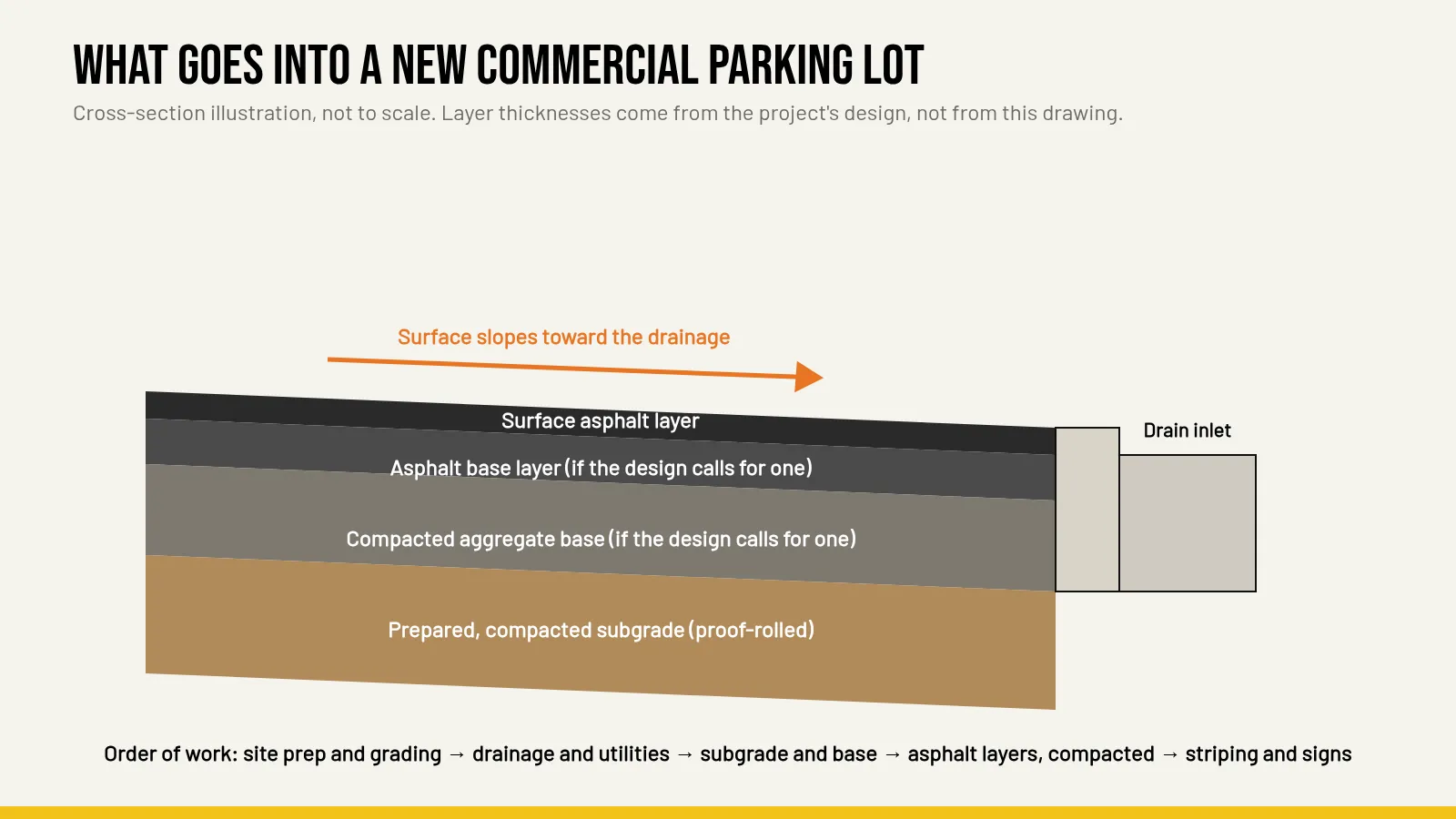 Illustration: the layers of a new lot, not to scale. Not a project drawing.
How thick should parking lot asphalt be for cars and for trucks?
There is no single number, because thickness follows the soil and the traffic. As a published example, MAPA’s guide sets out three traffic classes. Its 15-year design tables call for roughly 2.5 to 3 inches of asphalt over 6 inches of aggregate base for light traffic, 4 to 4.5 inches over 8 inches for moderate traffic and 6 to 7 inches over 10 inches for heavy traffic, with the lower end of each range for stronger soil.
- Light traffic means mostly cars and SUVs with occasional delivery trucks, fewer than about 1,500 vehicles a day.
- Moderate and heavy traffic add regular single-unit and combination trucks at higher daily counts.
- Truck lanes and dumpster pads stand out. MAPA notes that routine truck traffic through a lot designed for cars calls for a much thicker section, and suggests isolating the dumpster and loading route and giving it a heavy-duty design, with at least 6 inches of asphalt over 8 inches of base where the truck stops and loads.
Treat these figures as an example, not a Florida design. They come from a Missouri guide and assume a soil-strength rating (CBR) for the subgrade, and Florida soils and designs vary. The thickness for your lot should come from the engineer or geotechnical consultant who designed it, and a contractor’s proposal should state the thickness it is pricing in writing. The same guide recommends a qualified civil engineer for traffic beyond its heavy class.
Does a new parking lot need permits, stormwater review or ADA spaces in Florida?
Usually, yes to all three, but the details depend on the site, so confirm them with the agencies below. This is general information, not legal advice.
- Stormwater. Florida’s Environmental Resource Permit program regulates new activities on upland sites that generate stormwater runoff, according to the Florida Department of Environmental Protection. Applications are reviewed by one of the state’s water management districts. Sites near Lakeland and Orlando can fall under different districts, such as the Southwest Florida or St. Johns River districts. The St. Johns River district states that anyone proposing to build new commercial facilities must get a permit before construction, “with specific exemptions and permitting thresholds.” Thresholds are set in Rule 62-330.020, Florida Administrative Code, so ask the district which applies to your site.
- Local review. The City of Lakeland’s Development Review page says an approved site plan is required before building permits, and its review covers parking, stormwater management and accessibility and ADA compliance. The City of Orlando’s permit guide describes digital plan submittal and inspections, with a plan-review deposit for commercial projects. Sites outside city limits may be handled by the county or another jurisdiction, so confirm who reviews your site.
- Accessible parking. The 2010 ADA Standards require accessible spaces in every parking facility on a site, and at least one in every six accessible spaces must be van accessible, per the U.S. Access Board’s parking guide. The number scales with the size of the lot. The surface of accessible spaces, access aisles and accessible routes has slope limits (1:48 maximum), so the grading plan has to coordinate them with drainage. Florida adds its own rules in section 553.5041, Florida Statutes, including accessible spaces at least 12 feet wide, access aisles at least 5 feet wide and striped diagonally, and blue outlining and signs. Also see the Accessibility volume of the Florida Building Code.
Your civil engineer or the permitting agency is the right place to confirm what applies. A paving contractor’s proposal should say whether permits, striping layout and accessible-space design are included or by others.
How long until a new parking lot can open to traffic?
Asphalt can carry traffic soon after it has cooled, but the answer for a given lot depends on the mix, layer thickness, weather and what else is left to finish. The Wisconsin Asphalt Pavement Association notes in a technical bulletin that asphalt pavements can be used as soon as they have cooled. The Florida DOT’s roadway specifications (Section 330-10) protect newly placed layers from traffic until the surface temperature has cooled below 160°F, and allow artificial cooling to open sooner. Asphalt Institute guidance says thicker lifts take longer to cool inside. Those are roadway rules, not a promise for a parking lot.
For a new commercial lot, opening to customers can also depend on striping, signs, inspections and the building’s own approvals. Ask for a written schedule that shows the paving days, when striping happens and when the lot is expected to be usable, and allow for weather.
Should a commercial parking lot be asphalt or concrete?
Both are used, and the better choice depends on traffic, budget, schedule, soil and how the owner wants to maintain it. A fair comparison looks at life-cycle cost, not only the first price. The same Wisconsin Asphalt Pavement Association bulletin explains that a proper life-cycle cost analysis includes maintenance and rehabilitation for every option, because both asphalt and concrete pavements will need major rehabilitation during their service lives. Its bulletin is written by an asphalt industry group, so read it with that in mind.
- Schedule. Asphalt can be used once it has cooled. The National Ready Mixed Concrete Association’s guide specification for concrete parking lots calls for curing for at least three curing days and says not to open the pavement to vehicles until in-place strength reaches 3,000 psi or 75 percent of the specified strength, unless the engineer accepts it sooner.
- Joints. Jointed concrete lots are built with planned joints. Asphalt is placed as a continuous surface.
- Maintenance. Both need upkeep. For asphalt, see the commercial parking lot maintenance plan and the sealing and patching service.
A1 Paving is an asphalt paving contractor, so we can price an asphalt lot. If you want a concrete option compared, request that bid from a concrete contractor and compare the two against the same scope and life-cycle assumptions.
What should you prepare before asking for a commercial paving estimate?
Gather what defines the lot, and the estimate gets faster and more comparable. You do not need everything on the list.
- Site plan or civil drawings, including grading, drainage, utilities and any geotechnical (soil) report.
- Traffic, including delivery and trash truck routes, loading areas and dumpster pads, and the expected number of vehicles.
- Scope split: who does the clearing, grading, base, drainage structures, curbs and striping, and who pulls the permits.
- Permit status and any inspection or schedule milestones, including when the building opens.
- Site access, staging space and phasing, including which entrances must stay open.
- Striping and accessible-space layout, if one exists.
- The property address and photos of the site.
A1 Paving’s prepare for a paving estimate guide covers the photos, questions and scope items that make proposals easier to compare. When you compare bids, check that each states the layer thicknesses, base material, who handles permits, and what is excluded.
Commercial parking lot paving contractor near Lakeland and Orlando
If you are searching for a parking lot paving contractor near you, A1 Paving works from its Polk City base and serves Lakeland, Polk City and nearby Polk County communities, as well as the Orlando area. A1 Paving offers commercial asphalt paving for parking areas, and free estimates are available. Project availability should be confirmed for the property address.
Frequently asked questions
What are the steps to pave a new commercial parking lot? Site prep, grading, drainage, base, asphalt layers, compaction and striping, in that order. Debris and unsuitable soil come out, the subgrade is proof-rolled and compacted, drainage is built with a minimum 2 percent slope, a stone base is compacted where the design calls for one, asphalt goes down in layers that are compacted while hot, and stalls and accessible spaces are striped last.
How thick should parking lot asphalt be for cars vs. trucks? It follows the soil and the traffic. MAPA’s published 15-year example calls for about 2.5 to 3 inches of asphalt over 6 inches of base for light traffic, 4 to 4.5 inches over 8 inches for moderate traffic and 6 to 7 inches over 10 inches for heavy traffic, depending on soil strength. That is a Missouri example, not a Florida design. The engineer’s specification governs, and a proposal should state the thickness in writing.
Does a new parking lot need permits, stormwater review or ADA spaces in Florida? Usually yes, and the details depend on the site. Florida’s Environmental Resource Permit program covers new stormwater-generating sites, the City of Lakeland requires an approved site plan before building permits, the City of Orlando uses digital plan review and permits, and the 2010 ADA Standards and Florida Statutes section 553.5041 govern accessible parking. Confirm with the agencies and your engineer. This is not legal advice.
How long until a new parking lot can open to traffic? Asphalt can carry traffic once it has cooled, which can be soon after paving, but the time depends on the mix, thickness, weather, striping and any required inspections or approvals. FDOT’s roadway rule is 160°F surface temperature, which is not a parking lot promise. Ask for a written schedule.
Should a commercial parking lot be asphalt or concrete? Both are used. Compare them by life-cycle cost, including maintenance and rehabilitation for each, plus schedule and soil. Asphalt can open once cooled, while concrete lots require curing time and strength before opening. A1 Paving prices asphalt lots; get a separate bid for concrete.
What should I prepare before asking for an estimate? The site plan or civil drawings and any soil report, traffic types and truck routes, who handles grading, drainage, base and permits, the schedule and access, the striping and accessible-space layout, the address and photos.
Does A1 Paving do commercial parking lot paving in Lakeland and Orlando? A1 Paving offers commercial asphalt paving for parking areas from its Polk City base, serving Polk County, including Lakeland, and the Orlando area. Free estimates are available.
Conclusion
A new commercial parking lot is built in a set order: site prep and grading, drainage, a compacted subgrade and base, asphalt layers compacted while hot, then striping. Thickness depends on soil and truck traffic and should come from the design, not a rule of thumb. Plan early for stormwater and local site-plan review, accessible parking and a realistic opening schedule, and compare asphalt and concrete on life-cycle cost, not first price alone. For a site-specific look at a new lot in Lakeland, Orlando or Polk City, request a free estimate or call A1 Paving at (407) 966-5164.
Next step
Plan your project
Share the property location, intended use, and current surface condition, and A1 Paving will review the site and provide a written estimate.