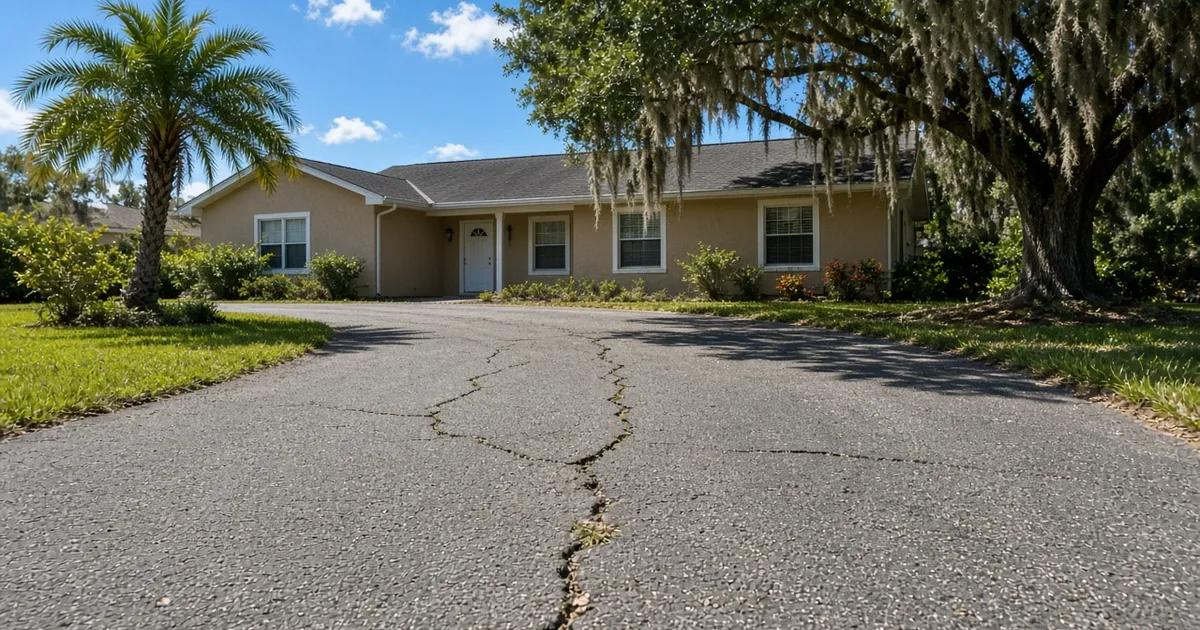
Illustration: a cracked asphalt driveway at a Central Florida home. Not an A1 Paving project.
Short answer: Asphalt crack repair depends on the kind of crack. Single cracks roughly ¼ inch to 1 inch wide, in pavement that’s still solid, are usually candidates for crack filling or crack sealing. Alligator cracking, a web of small connected pieces, usually means the base underneath is failing, and filling won’t fix it. That area needs a patch that removes the bad material, and widespread damage may call for resurfacing or replacement. In Lakeland, Orlando and Polk City, the drier months from mid-October to late May are the easiest time to schedule the work.
By Bill Cooper, A1 Paving, based in Polk City, FL.
Cracks are the first warning sign most driveways give. Fixing the right ones at the right time is one of the cheapest ways to protect asphalt. This guide explains why driveways crack in Central Florida, which cracks you can treat and which point to a deeper problem, and how crack filling, sealcoating, patching and resurfacing differ. For the service itself, see A1 Paving’s sealing and patching service.
Why is my asphalt driveway cracking?
Asphalt is crushed stone held together by a flexible, oil-based binder. Over time that binder hardens and the pavement loses flexibility, so it cracks instead of bending. In Central Florida the main drivers are:
- Sun and age. Strong, year-round sun dries out the binder at the surface. The driveway fades to gray, turns brittle and cracks more easily. The Asphalt Institute notes that a hardened binder can also lose its grip on the stone, which shows up as loose gravel on the surface (called raveling).
- Water. Caltrans’ crack-treatment guidance puts it simply: cracks give surface water a path into the pavement structure, where it causes damage. Florida gets almost 50 inches of rain a year, according to UF/IFAS, so an open crack doesn’t stay dry for long.
- A weak or wet base. If the stone base or soil underneath is soft, thin or wet, the asphalt flexes every time a car rolls over it, and fatigue cracks follow.
- Unsupported edges. Tires that run off the side of the driveway, or soil that washes away from the edge, leave the asphalt with nothing to rest on.
- Tree roots. Large oaks near a driveway can lift and crack the pavement as their roots grow.
Florida doesn’t get the hard freezes that crack driveways up north. Here the main problems are sun, water and the base. To learn how these factors affect the whole life of a driveway, see how long an asphalt driveway lasts in Lakeland.
Which cracks can be filled, and which mean base failure?
The pattern of the cracks tells you most of what you need to know. Federal Highway Administration (FHWA) and Caltrans pavement manuals group asphalt cracks into a few common types:
- Longitudinal and transverse cracks: single cracks running along the driveway or across it. When the pavement around them is solid, they’re the classic candidates for crack treatment.
- Block cracking: cracks that divide the surface into large, roughly rectangular pieces. Caltrans links this to age hardening of the asphalt. It can usually be treated with crack sealant if the pavement is still sound.
- Edge cracking: crescent-shaped or continuous cracks within about 2 feet of an unpaved edge, caused by overloading at the edge or loss of support. Caltrans notes that sealant alone doesn’t always work here.
- Alligator (fatigue) cracking: a web of small, sharp-angled pieces, usually less than about a foot across, that looks like alligator skin. It usually shows up where tires roll. The FHWA’s Distress Identification Manual describes it this way, and both Caltrans and the Asphalt Institute link it to repeated loads on a weak or wet base, or to pavement that’s too thin.
The key point: Caltrans states that neither crack sealing nor crack filling can treat alligator cracking, because it is a structural failure. It also notes that a single crack in the wheel path is often the first visible sign that alligator cracking is starting.
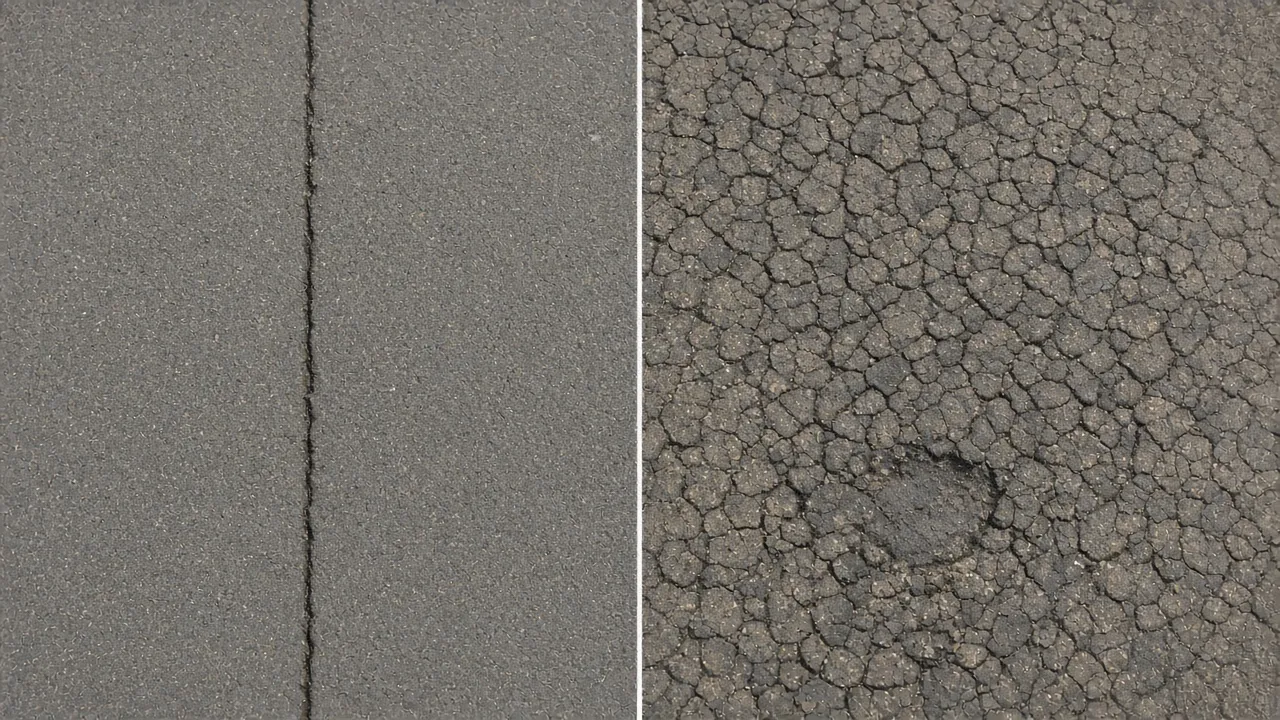 Illustration: a single crack in solid asphalt (left) next to alligator cracking (right). Not an A1 Paving project.
Crack type and likely fix
Use this as a starting point. An on-site look is the only reliable way to confirm what’s happening under the surface.
| What you see | What it usually means | Likely fix |
|---|---|---|
| Very fine hairline cracks on a faded, gray surface | Aging, oxidized surface; pavement still solid | Keep an eye on them; clean the surface and treat any cracks that open up before sealcoating |
| A single crack about ¼ to 1 inch wide, edges intact, no sinking | An open path for water; base likely still sound | Crack filling or crack sealing |
| Large rectangular blocks of cracks | Age-hardened asphalt | Crack sealing if the pavement is sound; if it covers most of the driveway, ask about resurfacing |
| Cracks along an unpaved edge | Edge overload or lost support | Edge repair or patching, plus fixing the edge and drainage |
| Alligator cracking in one area | Fatigue; the base or pavement is failing there | Full-depth patch down to firm support |
| Cracks with sinking, standing water or a pothole | Water has reached and weakened the base | Patch, and correct the drainage |
| Widespread cracking across most of the driveway | The surface, and possibly the base, is near the end of its life | Resurfacing if the base is sound; replacement if it isn’t |
Crack filling vs. sealcoating vs. patching vs. resurfacing
These four repairs often get confused, but each one does a different job. A1 Paving’s asphalt repair options guide compares them in more detail.
Crack filling and crack sealing
Both put material into a crack to keep water and debris out. The FHWA’s crack treatment manual draws a clear line between them:
- Crack sealing is for “working” cracks that open and close more than about ⅛ inch (3 mm) a year. It uses specially formulated, flexible materials that have to stick to the crack walls and stretch as the crack moves.
- Crack filling is for cracks that barely move. It uses less specialized material to cut down on water getting in and to support the pavement next to the crack.
The FHWA manual lists cracks of about 5 to 25 mm (roughly 3/16 inch to 1 inch) as candidates for filling. Caltrans guidance treats cracks between ¼ inch and 1 inch, and only when the pavement structure is sound. Caltrans also describes filling as a shorter-term treatment and sealing as a longer-term one.
Sealcoating
Sealcoating is a thin protective coat over the whole surface. It slows sun and water damage and restores the dark color. It doesn’t fill cracks or add strength, so cracks are treated first. For timing and prep, see our driveway sealcoating guide for Lakeland and Orlando and A1 Paving’s resource on when to sealcoat an asphalt driveway in Florida.
Patching
Patching replaces a defined failed area, such as alligator cracking or a pothole. The Asphalt Institute’s repair guidance says a lasting repair removes the failed material down to firm support, even part of the soil if needed. The cut-out should be square-edged and extend past the visible damage, and the new hot mix should be compacted, in two layers if the hole is deeper than 6 inches. Patch costs are covered in our guide to how much it costs to fill a pothole.
Resurfacing
Resurfacing (an overlay) adds a new layer of asphalt over the old one. It only works when the base is still sound, because cracks from a failing base tend to come back up through the new layer. Whether your driveway should be resurfaced or replaced is a separate decision. Our asphalt resurfacing vs. replacement guide walks through it.
What does professional asphalt crack repair involve?
Methods vary by contractor and material, but the FHWA and Caltrans manuals describe the same basic steps:
- Inspect and diagnose. Decide which cracks to treat, which to patch, and whether drainage or the base is part of the problem.
- Clean the cracks. Blow out dirt, sand and loose material, and remove weeds and grass.
- Make sure they’re dry. The FHWA manual warns that moisture in the crack can seriously weaken the bond.
- Shape the crack if needed. For sealing, some cracks are cut or routed to create a clean channel for the sealant.
- Apply the material. Hot-applied or other products are placed into or over the crack, following the manufacturer’s instructions.
- Let it cure. Caltrans notes that crews may dust tacky material with sand and keep traffic off until it cures.
When you compare estimates, ask which cracks are included, which material will be used, and whether any areas need patching instead.
When is the best time to fix driveway cracks in Central Florida?
Pick a dry stretch of weather. The FHWA manual notes that most crack filling can be done year-round, and that sealing working cracks works best in moderately cool weather, roughly 45 to 65 °F, when cracks are partly open. Either way, the crack has to be clean and dry.
In Central Florida, the drier months line up well with that advice:
- The National Weather Service Tampa Bay office, which covers Lakeland and Polk County, defines the rainy season as roughly May 25 to October 10.
- The National Weather Service in Melbourne, which covers Orlando, lists the median start of Orlando’s wet season as May 27 and of its dry season as October 15.
So late fall through spring is usually the easiest time to schedule crack work in Lakeland, Orlando and Polk City. The most important thing is to have cracks treated before the summer storms start, not after.
What happens if you don’t fix driveway cracks?
Cracks rarely stay small. Water gets in, softens the base, and traffic does the rest. The Asphalt Institute warns that alligator cracking left alone can become a full structural failure: pieces break away, potholes form, and moisture gets into the base. At that point a full-depth repair is needed. Caltrans says the same about fatigue cracking: if it isn’t repaired, it typically develops into potholes and pavement disintegration.
That’s why the order matters. Filling a crack while the pavement around it is still solid is a small job. Leaving it through a rainy season can turn it into patching, and widespread failure can turn it into resurfacing or replacement.
Can I repair asphalt driveway cracks myself?
Sometimes. A few narrow, isolated cracks in an otherwise solid driveway are a reasonable DIY job with a product made for asphalt cracks. Follow the label, and work on a dry day with a clean, dry crack. Skip rigid materials like cement mortar. The FHWA manual explains that crack materials need to stick to the crack walls and flex as the pavement moves.
Call a contractor when:
- you see alligator cracking, sinking, or cracks that keep reopening;
- cracks are wider than about an inch, or the edges are crumbling;
- water stands on the driveway after rain;
- there are potholes or broken pieces;
- you’re planning to sealcoat and want the cracks handled properly first;
- you’re not sure whether the base is still sound.
If you’re searching for asphalt driveway repair near me in Lakeland, Orlando or Polk City, ask each contractor to tell you which cracks they’d fill, which areas they’d patch, and why.
Areas A1 Paving serves
For asphalt repair in Lakeland, Orlando or Polk City, A1 Paving offers crack filling, targeted patching, sealcoating and targeted resurfacing for driveways and parking areas. A1 Paving is based in Polk City and serves Lakeland, Polk City and nearby Polk County communities such as Auburndale, Winter Haven, Lake Alfred, Haines City, Davenport and Bartow, as well as Orlando. For new driveways and replacements, see A1 Paving’s asphalt paving service. Free estimates are available.
Frequently asked questions
What is the difference between crack sealing and crack filling? Crack sealing uses flexible, specially formulated material for “working” cracks that open and close more than about ⅛ inch a year. Crack filling uses less specialized material for cracks that barely move. Both keep water and debris out of the pavement.
What size cracks should be filled in an asphalt driveway? Highway guidance from FHWA and Caltrans treats cracks from about ¼ inch up to about 1 inch wide, in pavement that’s still structurally sound. Wider, crumbling or interconnected cracks usually need patching instead.
How do you fix alligator cracks in an asphalt driveway? Not with crack filler. Alligator cracking usually means the base is failing, so the lasting fix is to remove the damaged area down to firm support and patch it with new compacted asphalt. If it covers much of the driveway, resurfacing or replacement may make more sense.
Do I need to fill cracks before sealing my driveway? Yes. Sealcoat is a thin surface coating that doesn’t fill cracks or add strength. Cracks should be cleaned and treated, and failed areas patched, before the driveway is sealed.
What is the best time to fill asphalt cracks in Central Florida? On a dry day, with clean, dry cracks. In Lakeland and Orlando, the drier months from about mid-October to late May are usually easiest, and it’s best to have cracks treated before the summer rainy season.
Can you use cement or sand to fill cracks in an asphalt driveway? It isn’t recommended. Asphalt moves with heat and traffic, and crack materials need to stick to the crack walls and flex with it. Use a product made for asphalt cracks, or have a contractor treat them.
Does A1 Paving repair asphalt cracks in Lakeland and Orlando? Yes. A1 Paving offers crack filling, patching, sealcoating and targeted resurfacing from its Polk City base, serving Polk County, including Lakeland, and the Orlando area. Free estimates are available.
Conclusion
Asphalt crack repair is all about matching the fix to the crack. Single cracks about ¼ to 1 inch wide, in pavement that’s still solid, can usually be filled or sealed. Alligator cracking, sinking and potholes mean the base is involved and the area needs a proper patch. Widespread damage leads to the resurfacing-or-replacement question. In Central Florida, try to have cracks treated in the drier months, before the summer storms push water into the base. Then sealcoat once the repairs are done. If you want a clear answer for your driveway in Lakeland, Orlando or Polk City, request a free estimate or call A1 Paving at (407) 966-5164.
Next step
Plan your project
Share the property location, intended use, and current surface condition, and A1 Paving will review the site and provide a written estimate.