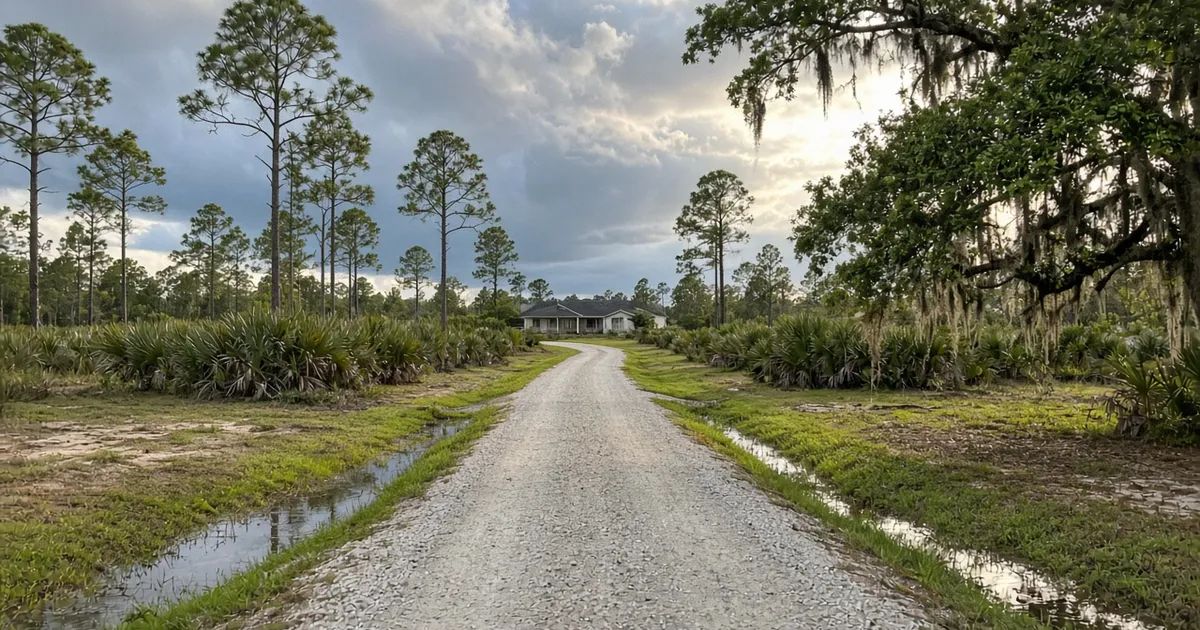
Illustration: a crowned gravel driveway shedding rain into grassy side swales. Not an A1 Paving project.
Short answer: A gravel driveway washes out when water runs along it instead of off it. Good gravel driveway drainage comes down to four things: a crown (a slightly higher center) so rain sheds to the sides, clear swales or ditches that carry that water away, a firm compacted base under the stone, and a working culvert wherever the drive crosses a ditch. In Polk City, Lakeland and across Polk County, fixing the water path matters far more than adding stone.
By Bill Cooper, A1 Paving, based in Polk City, FL.
If your gravel driveway turns into a creek in every storm, this guide explains why and what fixes it. It’s also worth reading before a new gravel driveway installation, because drainage is easier to build in than to add later. For help on your property, see A1 Paving’s stone and gravel driveway service.
Why does my gravel driveway wash out?
Loose stone doesn’t move on its own. Water moves it. A washout starts when rain runs down the surface, usually in the tire tracks, carrying off the fine material that binds the stone, then the stone itself.
The usual causes are:
- No crown. A flat or dished drive lets water sit or run straight down it.
- Ruts. Two wheel ruts become two small channels.
- Edge berms. Stone and sod build up at the sides and trap water like a curb.
- Outside runoff. Downspouts, a higher yard or a neighbor’s lot send water across the gravel.
- Blocked swales or culverts. Water that can’t leave backs up onto the drive.
- A soft base. Stone over loose sand or organic soil sinks, ruts and holds water.
The Federal Highway Administration’s Gravel Roads Construction and Maintenance Guide puts it plainly, quoting an old road-building saying: the three most important things are “drainage, drainage, and drainage.” The guide is written for public gravel roads, but a long rural driveway behaves much the same way.
What is crowning, and how much crown does a gravel driveway need?
Crowning means shaping the driveway so the center is a little higher than the edges, like a very low roof. Rain runs sideways to the edges in a few feet instead of down the whole drive. On narrow drives, a steady tilt to one side (a cross-slope) can do the same job.
For gravel roads, the FHWA guide says experienced operators recommend about ½ inch of crown per foot, roughly 4 percent, as a straight line rising from the edge to the center. It warns against going beyond 6 percent, because too much crown makes vehicles feel like they’re sliding off. A home driveway isn’t a county road, so the right shape depends on its width, slope and use, but the idea holds: without a crown, water stays on the surface and starts ruts.
Crowns wear down as tires and raking move stone around, so check the shape once or twice a year.
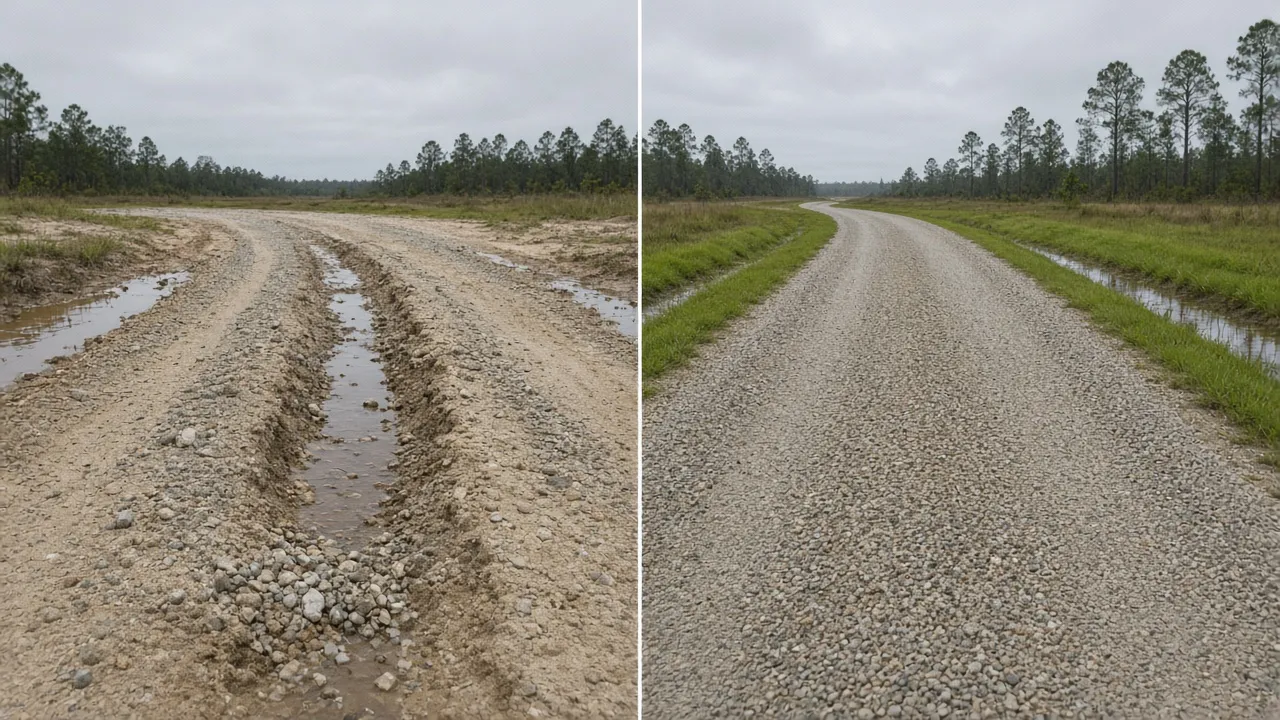 Illustration: a flat, washed-out gravel drive (left) next to a crowned drive that sheds water to a side swale (right). Not an A1 Paving project.
How do you fix standing water or puddles on a gravel driveway?
A puddle that lasts for hours after rain means the spot is low or the water has nowhere to go. Dumping loose stone into it just gives the next storm more to move.
Small puddles and potholes
- Rake out loose material and mud from the low spot.
- Refill with compactable crushed stone, not round decorative rock, in thin layers.
- Compact each layer and finish slightly high, blended into the crown, so water runs to the edge.
Puddles that keep coming back
If the same spots hold water every rainy season, the shape or the base is the problem. Common fixes:
- Regrading to restore the crown or cross-slope along the full drive.
- Removing edge berms so water can leave the surface. The FHWA guide notes that on fairly level ground, water trapped behind a built-up shoulder seeps into the soil and softens the whole roadway, a common situation on flat Florida lots.
- Rebuilding soft spots by digging out wet or organic soil and replacing it with compacted base stone.
Water coming from somewhere else
Watch where water comes from during a storm. UF/IFAS Extension’s Florida-Friendly Landscaping program recommends directing downspouts into landscaped or pervious areas and using swales to slow runoff. Turning a downspout away from the drive, or adding a shallow swale above it, takes water off the gravel.
Does a gravel driveway need a base or fabric?
The base
Yes. Any stone driveway installation that will carry cars needs a compacted base. Under the visible stone is a prepared subgrade (the native soil) and a base of angular, graded stone that locks together when compacted. Stone spread straight onto loose sand ruts, sinks and wanders into the lawn, and ruts are where washouts begin.
A1 Paving’s guide to choosing gravel for a Florida driveway explains which stone works as base and which suits the top layer: angular, well-graded stone compacts and holds, while round decorative stone tends to roll.
Fabric (geotextile)
Geotextile is a woven or non-woven fabric laid on the soil before the stone goes down. The FHWA guide describes it as a separator for weak, wet ground: it keeps fine silt and clay from pumping up into the stone under traffic while letting water pass through. It doesn’t replace drainage, base depth or compaction. If your site has soft or wet spots, ask your installer whether a geotextile is needed and which type.
Are ditches, swales or culverts needed?
Often, yes. A crown only moves water to the edge. Something has to carry it away.
Swales and ditches
A swale is a shallow, grassy dip that carries runoff slowly to a safe outlet or lets it soak in. A ditch is usually deeper. Keep both clear of sand, leaves and storm debris, and make sure they lead somewhere lower. The FHWA guide warns that regrading which strips ground cover can cause erosion that clogs culverts and ditches, so let grass re-establish after work.
Culverts
A culvert is a pipe that carries water under the driveway, usually where it crosses a roadside ditch. The FHWA guide warns that small culverts plug easily with eroded soil and debris and should be inspected and cleaned regularly.
The ditch and the pipe at the road are often in the public right-of-way. On county roads, Polk County’s Roads and Drainage Division maintains the county-owned roadway and drainage infrastructure. Before you add, replace or change a culvert or apron at the road, check with Polk County, or your city if you’re inside city limits, about what’s required, and ask your contractor who handles any permit.
Is gravel or asphalt better for drainage?
- Gravel lets some rain soak through the gaps between stones. UF/IFAS’s Florida-Friendly Landscaping guidance encourages permeable driveways so rain can soak into the ground. But once the surface packs down or ruts, water runs across it and loose stone can wash away.
- Asphalt is a solid surface, so rain runs off and it must be graded to send water to swales. It doesn’t wash out like gravel, but water that gets under it leads to cracks and potholes.
If you’re thinking about switching to asphalt, see our asphalt paving service and our comparison of asphalt vs. concrete driveways in Polk City and Lakeland. For budget questions, our guide to what drives the price of a gravel driveway in Polk County covers base, stone and drainage.
How do Florida’s rainy and hurricane seasons affect a gravel driveway?
The National Weather Service Tampa Bay office, which issues forecasts for Lakeland, defines the West Central Florida rainy season as roughly May 25 to October 10, with the peak from July through early September. The National Hurricane Center lists the Atlantic hurricane season as June 1 to November 30. UF/IFAS notes that Florida receives almost 50 inches of rain a year.
That suggests a simple routine:
- Before late May: restore the crown, fill low spots, cut back berms, and clear swales and culverts.
- After big storms: look for new ruts, stone fanned out at low spots, and debris in the culvert.
- After the season: fix what summer revealed while the ground is drier.
Areas A1 Paving serves
A1 Paving is based in Polk City and installs and repairs stone and gravel driveways in Lakeland, Polk City and nearby Polk County communities such as Auburndale, Winter Haven, Lake Alfred, Haines City, Davenport and Bartow, as well as Orlando. Free estimates are available.
Conclusion
Good gravel driveway drainage keeps a Polk County driveway in place by giving water a clear path off it and away from it. Most washouts trace back to a worn-down crown, ruts, edge berms, outside runoff, blocked swales or culverts, or a weak base. Small puddles can be raked, filled and compacted. Spots that wash out every rainy season usually need regrading, base repair or better swales, not more stone. When you plan a new drive or a repair, ask any contractor where the water will go. If you want a clear plan for your driveway, request a free estimate or call A1 Paving at (407) 966-5164.
Frequently asked questions
Why does my gravel driveway keep washing out? Water is running along it instead of off it, usually because of a missing crown, ruts, edge berms, outside runoff or blocked swales. Fix the water path first, then replace lost stone.
How do I stop water from pooling on my gravel driveway? Rake out the low spot, refill with compactable crushed stone in thin layers, compact it and blend it into the crown. If puddles return, the drive likely needs regrading or base repair.
What is a crown on a gravel driveway? A crown is a slightly higher center that sheds rain to both edges. FHWA guidance for gravel roads recommends about ½ inch per foot from edge to center, roughly 4 percent, and no more than 6 percent.
Do I need fabric under a gravel driveway? Not always. A geotextile can help separate stone from soft, wet soil, but it doesn’t replace a compacted base or good drainage.
Does a gravel driveway need a culvert? Where it crosses a ditch or drainage path, yes. Keep the pipe clear, and check with Polk County or your city before changing anything in the right-of-way.
Is gravel better than asphalt for drainage? Gravel lets some water soak in, while asphalt sheds it to the edges. Both need grading and swales. Loose gravel can wash out; asphalt can crack if water gets under it.
Does A1 Paving install gravel driveways in Polk County? Yes. A1 Paving installs stone and gravel driveways from Polk City across Polk County, including Lakeland, and offers free estimates.
Next step
Plan your project
Share the property location, intended use, and current surface condition, and A1 Paving will review the site and provide a written estimate.