- Parking Lot Maintenance
- #Parking Lot Maintenance
- #Asphalt Overlay
- #Commercial Asphalt Paving
- #Lakeland
- #Orlando
- #Polk City
- #Polk County
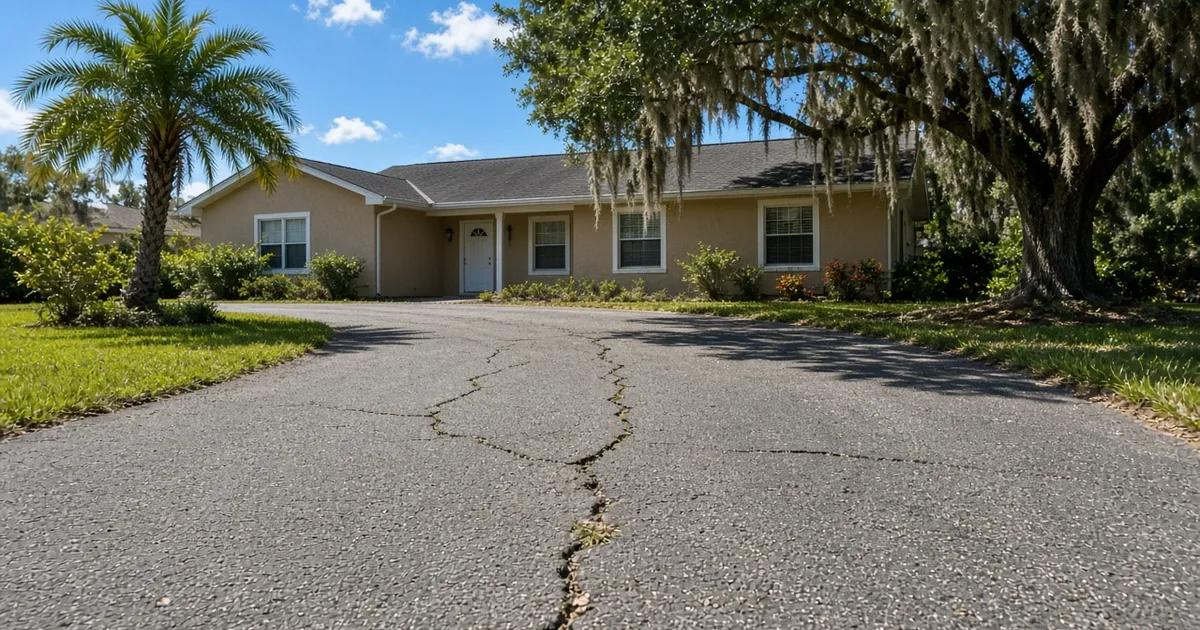
Illustration: a faded commercial parking lot at a Central Florida building. Not an A1 Paving project.
Short answer: Parking lot resurfacing puts a new asphalt surface on a lot whose support is still sound. An asphalt overlay places a new layer on top after failed spots are repaired; the finished surface goes up unless edges are adjusted. A mill-and-pave first mills off a planned depth of the worn surface, then places new asphalt, which helps hold elevations at curbs, drains and accessible routes. A full rebuild is more likely when the base has failed — widespread alligator cracking, settlement, pumping, extensive potholes or drainage problems a new surface would not fix.
By Bill Cooper, A1 Paving, based in Polk City, FL.
Worn parking lots in Lakeland, Orlando and Polk County often need more than patching, but not always a complete tear-out. This guide covers overlay versus mill-and-pave, when a rebuild is the more honest path, closure time, restriping and ADA re-marking, and what to prepare. For the broader resurface-or-replace decision, see A1 Paving’s asphalt resurfacing vs. replacement guide. For new parking areas built from the base up, see our guide to commercial parking lot paving for a new lot and the asphalt paving service.
When does a parking lot need an overlay, a mill-and-pave or a full rebuild?
Start with what is failing, and whether the pavement underneath can still support traffic. FHWA treats a thin asphalt overlay as a preservation treatment when the existing pavement is still in good structural condition, with only limited, low-severity cracking, minor surface rutting and working drainage. It is not meant to add meaningful structural capacity, and it is a poor fit once fatigue (alligator) cracking or other structural failure is underway, unless those areas are repaired first.
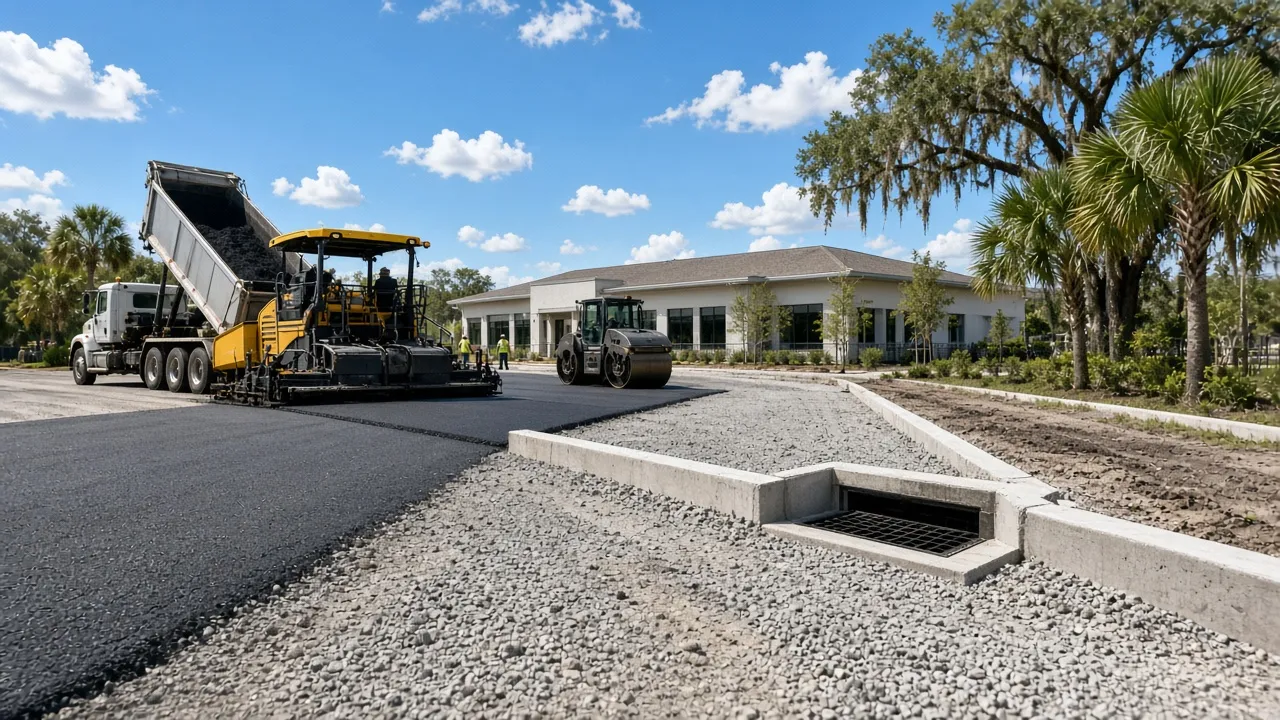
A straight asphalt overlay can fit a generally stable lot with mostly surface wear, if drainage and transitions will still work after the finished elevation goes up. A mill-and-pave (also called mill-and-overlay) is often better when the support is still dependable but the surface needs to come off — the lot is rutted, rough or oxidized, or another layer would create poor transitions or trap water. FHWA notes that milling is commonly used to restore profile and, when rutting is deeper than about ¼ inch, to re-establish cross slope so the new mat has a uniform thickness. Milling also makes room for the new surface so the lot does not rise at curbs and inlets.
A full rebuild deserves priority when the existing system is not a dependable platform: widespread interconnected cracking, settlement, pumping, extensive potholes, severe rutting, failed edges or recurring drainage problems. Localized full-depth repair can be combined with resurfacing when most of the lot is still suitable. Compare options in A1 Paving’s asphalt repair options guide. An on-site review is the only reliable way to confirm what is under the surface.
| What you see | More likely direction |
|---|---|
| Stable lot, faded surface, limited cracking, room at curbs and drains for a slightly higher surface | Asphalt overlay, after repairs |
| Sound support, but ruts, a rough surface, or too little room to raise the elevation at curbs, drains or accessible routes | Mill-and-pave |
| Widespread alligator cracking, settlement, pumping, extensive potholes or drainage problems a new surface would not fix | Full rebuild, or full-depth repair of failed areas plus resurfacing where the lot is still sound |
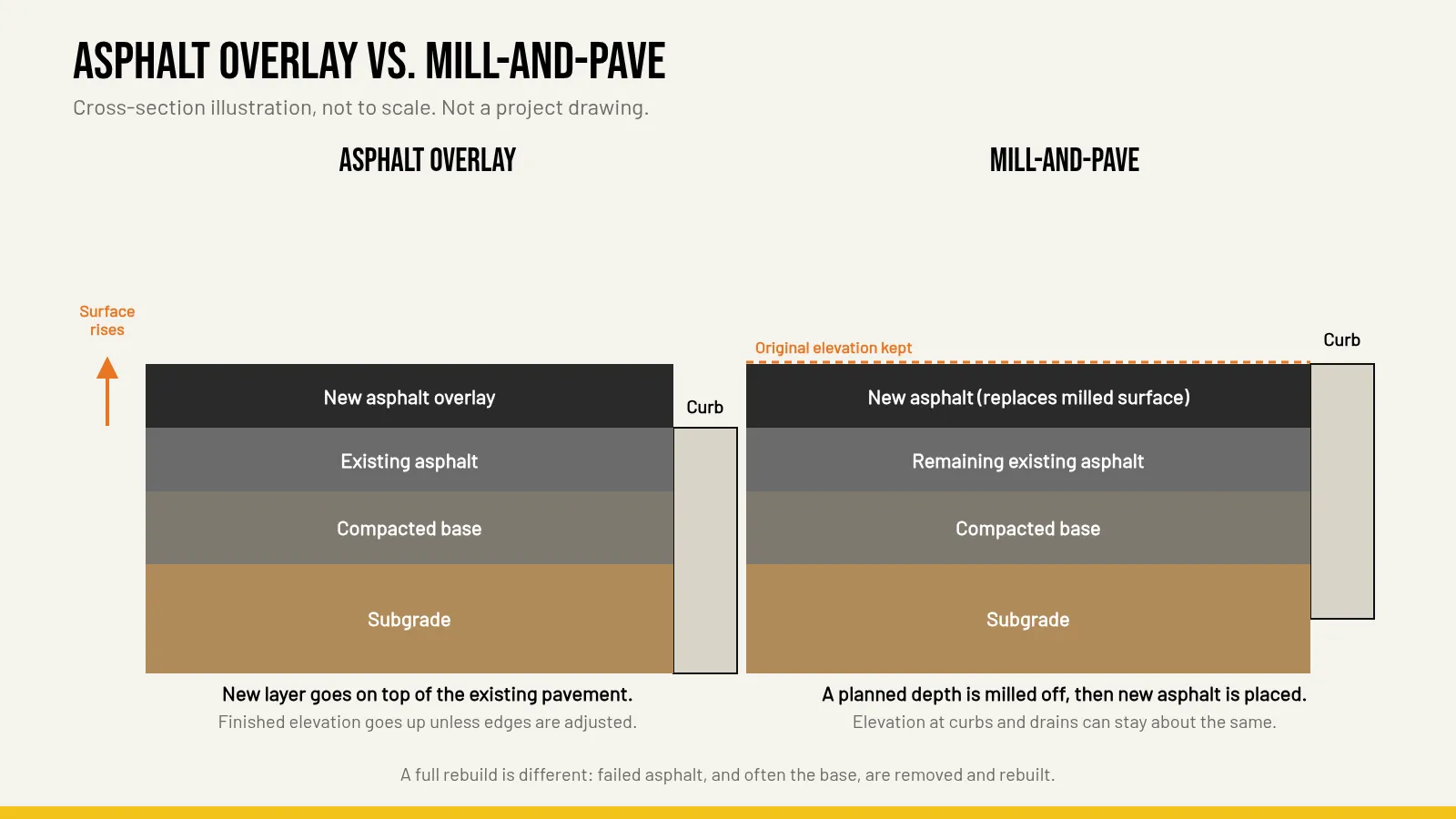 Illustration: an asphalt overlay raises the surface; a mill-and-pave holds the original elevation. Not to scale, and not an A1 Paving project drawing.
How long does an asphalt overlay last?
It depends on the pavement underneath, traffic, drainage, climate, thickness and materials, how well the lot was prepared, and the maintenance that follows.
For thin asphalt overlays — dense-graded mixes less than 1½ inches thick — FHWA’s June 2019 tech brief (FHWA-HIF-19-053) reports observed service-life extensions from highway agencies. In warm, wet, no-freeze climates like Florida’s, those ranges often fall between about 5 and 12 years (for example, South Carolina 5–8, Alabama 8–12, Louisiana 12+). The figures do not distinguish traffic or existing pavement condition. They are highway-program observations, not a promise for any one commercial lot, and a thicker overlay or a mill-and-pave is a different treatment.
Central Florida’s year-round sun and long rainy season — from late May to mid-October, per the National Weather Service and the Melbourne office — are hard on asphalt. A commercial parking lot maintenance plan is what helps any resurfacing last.
How long is the parking lot closed, and when can cars drive on it?
The asphalt itself can often take traffic once it has cooled enough. Florida Department of Transportation specifications (Section 330-10) require newly finished dense-graded friction course, and the last structural layer before it, to be kept off limits until the surface has cooled below 160°F. Asphalt Institute magazine notes that a typical two-inch surface can often be ready shortly after the final roller pass, while thicker lifts take longer to cool inside. Those rules come from roadway work; they describe when the mat is cool enough, not how long a whole parking-lot job takes.
Resurfacing also includes preparation, repairs, sometimes milling and restriping. Work can often be phased so some stalls or an entrance stay open. How long a given lot stays closed should be in the written scope, including when cars may return after markings are applied. Ask for those details when you prepare for a paving estimate.
Does parking lot resurfacing require restriping and ADA re-marking?
Yes. A new asphalt surface covers the old lines, so the lot has to be restriped, and accessible parking has to be brought up to current rules.
Under the ADA Standards, resurfacing a vehicular way is an alteration, not ordinary maintenance. The U.S. Access Board notes that “alterations” includes resurfacing of vehicular ways, and that resurfacing or resealing a parking facility must include accessible spaces as required. Refreshing striping in place for a few spaces, or filling potholes, is typically normal maintenance, unless the work affects usability.
When a lot is restriped, ADA.gov states that accessible parking must be provided as required by the 2010 ADA Standards. The number is calculated separately for each parking facility, and one of every six accessible spaces — but always at least one — must be van accessible. Spaces belong on the shortest accessible route to an accessible entrance. This is general information, not legal advice; confirm requirements with your local building official.
Florida also has its own accessible-stall rules, including width and the blue outline. Those dimensions, and paint versus thermoplastic, are in A1 Paving’s guide to parking lot line striping in Florida. See also line striping and thermoplastic pavement markings for high-wear arrows and crosswalks.
Can you resurface a parking lot over cracks and potholes?
Not as a shortcut. Failed areas should be repaired first. An overlay covers the pavement that remains; cracks or movement left active below can reflect through the new layer. FHWA’s thin-overlay guidance calls for patching isolated severe distress and for sealing or filling moderate and severe cracks before the new surface goes down. The Asphalt Institute treats alligator cracking as a structural problem — a weak or wet base, too little thickness, or overload — that can progress to potholes if it is ignored.
Isolated potholes in otherwise sound pavement are usually a patching job, not a reason by themselves to resurface the whole lot. See how pothole repairs are priced and done and A1 Paving’s sealing and patching service. Alligator cracking or sinking usually means the base is involved; those signs are covered in the guide to asphalt crack repair in Lakeland and Orlando.
What should a property manager prepare before parking lot resurfacing?
The estimate is only as good as the information behind it. Before a site visit, it helps to gather:
- The property address, a rough area, and photos: wide views, damage, edges and transitions, drains, and wet-weather ponding when it can be documented safely.
- How the lot is used: peak hours, deliveries, dumpster service, and which entrances or stalls must stay open.
- Pavement history: approximate age, previous overlays or patches, utility cuts, and spots that keep failing.
- Drainage observations: where water stands and any landscaping or roof drainage that sheds onto the lot.
- A site plan or current striping layout, if you have one, including accessible spaces.
You do not need exact measurements to request an estimate. The contractor should confirm the work limits on site. A1 Paving’s prepare for a paving estimate guide covers the photos, questions and scope items that make proposals easier to compare, including phasing, cooling and reopening assumptions.
Areas A1 Paving serves
For commercial asphalt paving and targeted resurfacing of parking areas in Lakeland, Orlando or Polk City, A1 Paving works from its Polk City base and serves Lakeland, Polk City and nearby Polk County communities such as Auburndale, Winter Haven, Lake Alfred, Haines City, Davenport and Bartow, as well as Orlando. Free estimates are available; project availability should be confirmed for the property address.
Frequently asked questions
When does a parking lot need an overlay vs. a mill-and-pave vs. a full rebuild? An overlay can fit a generally stable lot with mostly surface wear and room for a slightly higher elevation. A mill-and-pave is more likely when the surface should be removed — for ruts, roughness or to hold elevations at curbs and drains — but the support still looks dependable. A full rebuild is more likely when the base has failed.
How long does an asphalt overlay last? It depends on the pavement underneath, traffic, drainage, climate, materials and later maintenance. For thin overlays (less than 1½ inches), FHWA has reported service-life extensions in warm, wet climates that often fall in a roughly 5–12 year range. That is highway-program experience, not a promise for any one parking lot.
How long is a parking lot closed for resurfacing? The new asphalt can often take cars once it has cooled enough; FDOT uses a 160°F surface-temperature threshold on roadway work. The whole job also includes preparation, repairs, sometimes milling, and restriping, and it can be phased. Ask for closure details in the written scope.
Do you have to restripe and redo ADA markings after resurfacing? Yes. New asphalt covers the old lines, and resurfacing a parking lot is an alteration under the ADA Standards, so accessible spaces must be provided as required, including van-accessible spaces. Confirm requirements with your local building official.
Can you resurface over cracks and potholes? Not as a substitute for repair. Isolated cracks and potholes should be treated or patched first. Alligator cracking or sinking usually means the base needs a deeper repair, or a rebuild.
What should a property manager prepare before the work? Share the address, photos, how the lot is used, which areas must stay open, drainage observations, pavement history and, if you have it, the current striping and accessible-space layout.
Does A1 Paving resurface parking lots in Lakeland and Orlando? A1 Paving offers targeted resurfacing for driveways and parking areas, and commercial asphalt paving for parking areas, from its Polk City base, serving Polk County, including Lakeland, and the Orlando area. Free estimates are available.
Conclusion
Parking lot resurfacing works when the pavement that remains can support a new surface. An overlay adds a layer on top; a mill-and-pave takes off a planned depth first so elevations at curbs, drains and accessible routes can stay workable. A full rebuild is the more honest choice when the base has failed. Repair failed cracks and potholes first, then restripe, including accessible parking. For a site-specific look at a lot in Lakeland, Orlando or Polk City, request a free estimate or call A1 Paving at (407) 966-5164.
Next step
Plan your project
Share the property location, intended use, and current surface condition, and A1 Paving will review the site and provide a written estimate.